“A startup from California can expand and raise money all across the United States. But our companies still face way too many national barriers that make it hard to work Europa-wide, and way too much regulatory burden.”
– Ursula von der Leyen, Oct 2024
European startups are just as innovative, talented, and ambitious as their American counterparts. However, they continue to face a number of structural obstacles that make scaling within Europe significantly more difficult. One of the key challenges lies in establishing an appropriate legal entity, as companies remain largely bound by the national corporate laws. As a result, startups often face fragmented legal regimes from the earliest stages of development, which complicates cross-border operations, investment, and expansion.
One of the solutions increasingly discussed at the European level is EU-INC, a proposal for a new legal company form designed primarily for high-growth innovative businesses. Its objective is to create a standardized corporate framework across the European Union and allow startups to operate under modern, harmonized rules regardless of the country of incorporation.
The four key pillars of the EU-INC proposal
1. Core Corporate Principles
Today, incorporating a company and expanding it across the European Union remains complex due to differing national legal systems governing corporate structure, share transfers, and investor participation. These differences are particularly problematic when startups seek cross-border investment or rapid scalability. EU-INC proposes a private limited liability company with share capital. This means that shareholders’ personal assets would remain protected from company liabilities, while their financial exposure would be limited to the amount of capital invested. The company would require at least one shareholder and one director, with no residency restrictions for either. The proposal also does not foresee any minimum capital requirement.
A part of the proposal is the creation of digital tools designed to simplify and standardize corporate administration.
EU-Registry
EU-Registry is envisioned as a centralized digital company register at EU level. It would allow fully electronic filing of corporate documents and enable complete digital incorporation. The system would provide companies with a unified legal identity across Member States, eliminating the need for repeated registrations. A key component is the proposed Open API, which would allow third-party service providers to build external solutions and alternative interfaces connected directly to the registry. The goal is to reduce administrative costs, shorten incorporation time, and harmonize core corporate procedures.
EU-Dashboard
EU-Dashboard is designed as a central interface for managing a company and interacting with EU-Registry. Through the dashboard, company administrators would be able to generate corporate documents, execute share transactions, manage the cap table, and store certified agreements. Changes in ownership structure would be automatically reflected in the central registry.
EU-FAST
To facilitate early-stage fundraising, the proposal introduces EU-FAST, a simplified open-source investment instrument comparable to SAFE, BSA AIR, or convertible loan notes. Under this model, investors provide capital upfront while the right to convert that investment into equity arises only upon a predefined trigger event, such as a future financing round. The proposed instrument is intended to reduce legal costs, shorten transaction timelines, and simplify cross-border investment processes. Unlike traditional convertible instruments, EU-FAST would not include maturity dates or interest obligations, giving founders greater flexibility during the early stages of growth.
2. Share options
One of the most persistent challenges for European startups is attracting and retaining top talent, particularly when early-stage companies cannot yet compete through salary alone. To address this, the proposal includes EU-ESOP, a unified European employee share option framework primarily designed for small and fast-growing companies.
The proposal foresees that gains realized by employees upon selling shares would be treated as capital gains and taxed under the rules applicable in the employee’s country of tax residence. Tax liability would arise only at the moment of sale. A minimum holding period of one to three years is also estimated. This framework would allow startups to integrate employees more effectively into company ownership and improve competitiveness in the European talent market.
3. Taxation
Tax remains one of the most sensitive aspects of the EU-INC proposal. Current tax systems rely primarily on the concept of a company’s main place of management in determining tax residency. Because EU-INC is designed to facilitate seamless cross-border operations, multiple jurisdictions could potentially claim taxing rights over the same profits.
It is important to emphasize that EU-INC does not currently introduce a unified European tax regime. Taxation remains within the competence of Member States. However, the proposal opens the possibility for future development of more coordinated reporting and allocation mechanisms for companies operating across multiple EU jurisdictions.
3. Employment
In the area of employment law, the proposal does not seek to override national legal systems. Member States would retain full autonomy over labor law, while EU-INC aims to ensure that employees are properly informed and consulted on important company matters. The proposal does not introduce automatic employee representation on boards or mandatory voting rights, but instead promotes a dialogue between employers and employees while leaving governance fully within the competence of company management.
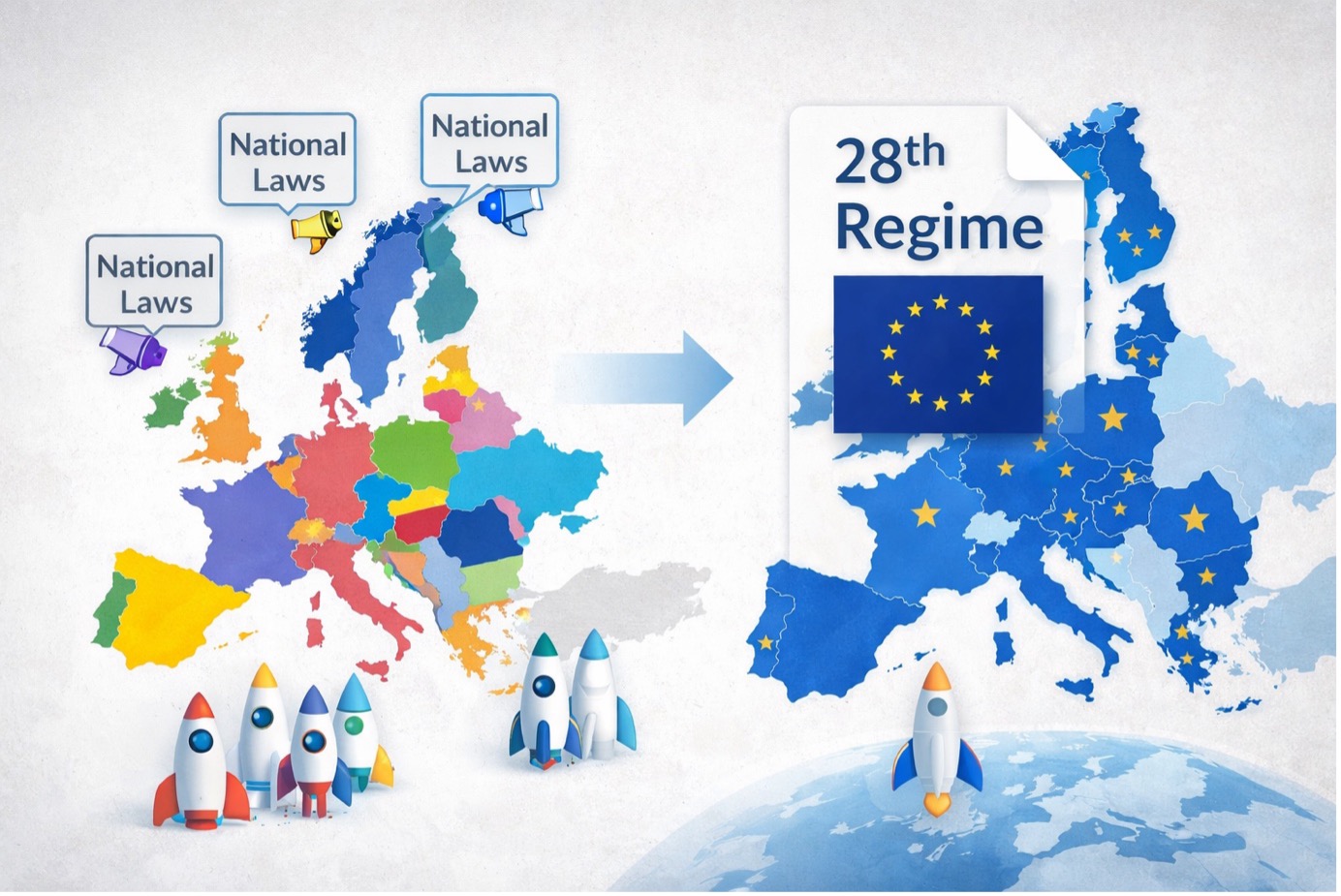
European institutions have recently shown growing interest in developing what is often referred to as the »28th regime«. The concept is sometimes described as a 28th virtual state, since such a framework would introduce a single set of directly applicable rules across all Member States without requiring separate national implementation. At this stage, however, EU-INC remains a policy proposal and industry-led initiative rather than formally adopted legislation. However, if adopted, EU-INC could significantly simplify the process of creating and scaling up startups in Europe, while also strengthening the competitiveness of the European innovation ecosystem in relation to the United States and China.
Key implications for EU investors
- Easier cross-border investing
- Faster and cheaper early-stage deals
- Greater market liquidity and deal flow
- Improved transparency through digital infrastructure
- Standardised cap-table and share transactions
- Stronger talent incentives
- No immediate tax harmonisation
- Potential jurisdictional tax complexity
- Reduced founder relocation to the US
Get more information about EU-INC HERE.